The old adage says if you see it, you can believe it. Modern technology, as it has with so many old adages, challenges that belief.
Most people, when answering honestly, would concur that photographs have been subject to some ‘customization’ for some time. Heck, modern language has even come up with a well-known term for it, ‘Photoshopping’ (much to the dismay, I expect, to the Adobe folks, authors of the photo program of the same name). Many digitally-altered photos are done in the name of humor, or satire, falling into the category of ‘mostly harmless’ (blatant nod to ‘The Hitchhiker’s Guide to the Galaxy’. Sorry.) Other uses are more notorious, of course, trying to create a false narrative about someone or something.
But a lot of folks may not may have noticed the sheer depths that computer-based image alteration has come. Presenting, for example and for consideration, the website http://thispersondoesnotexist.com. When first opened, the site presents a picture of a person’s face. Pressing refresh/F5 will yield another face, then another, and so on. Rather endless entertainment on a freezing day. Except these are not photographs of actual people; rather, every one of these is a computer-fabricated image of a face. As you would expect, there is a shedload of math involved in such complex graphic programming, which the authors detail quite thoroughly, and which your casual hacker likely would become bored with quite quickly. But down the road, like many things such as calculators, cell phones, and microwave ovens, the technology to create these images will surely become mainstream shortly.
Then there is the reuse of existent photographic evidence to support a writer’s position on something. These are things like old photos re-captioned as if they were recent, and the like. A more recent phenomenon speaks volumes about the quality of today’s video game graphics. In this example
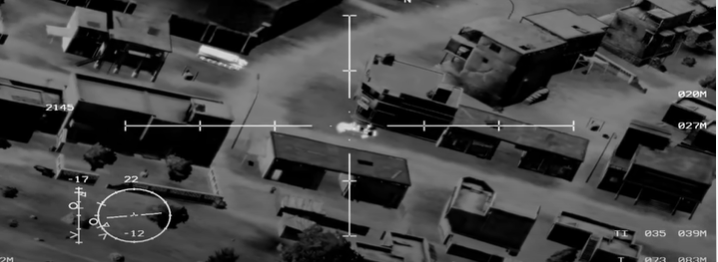
the photograph reportedly showed activity from the current Ukrainian conflict, and many people were convinced of its authenticity. We have become accustomed to such images on the news for years. However, research revealed this image was actually a screenshot from the videogame ‘AS-130 Gunship Simulator’. That so many believed is testament to the realistic graphics these games are now presenting.
But distrusting photographic ‘evidence’ is not particularly new, and many folks instead say they will rely only on video evidence. Well, the news on that front is not good. Recent technical innovations have created the phenomenon known as ‘deep fakes’. Basically, this allows the user to create video streams that either do not in fact exist, or that originally existed but are since altered to present a different flavor of event than the original presented. Again, many of the uses of this technology have been to produce comedy, satire, or parodies, which would largely also fall into the category of ‘mostly harmless’. But we are now seeing the dark underside to this tech, namely the production of fake videos for nefarious purposes.
Some of these uses involve pornography, which has always been an early adopter of new technology. What we are talking about here are other peoples’ faces being ‘projected’ (a wholly inadequate word for this) onto the heads and bodies of people performing sex acts. There must be a market for such videos, else that industry would not make them. This limited use would at least impact a limited number of people: the ones being ‘projected’ and the consumers buying this output.
There are other uses for this technology that can impact *all* of us, and not at all for the better. Imagine the power of a fake video in which a famous politician or candidate appears to voice a position in conflict with prior statements, or in conflict with known voter sentiments, or in fact as a confession of sorts. Such contrived media has the power to sway massive numbers of voters, especially given Americans’ limited attention span for verifying such things. (I know it’s hard; see the https://innoparticularorder.blog/2022/01/17/speech/ post of not long ago.)
Just how powerful is this relatively new technology? I promise to stay away from the math involved, but will insert this link https://www.youtube.com/watch?v=PINeQV0LH6k and you can yourself view just how far this has come. This is a compilation of some fairly well-done deep fake videos where, for example, Sylvester Stallone’s face replaces Schwarzenegger’s face in the ‘Terminator’ film. Yeah, yeah, occasionally an artifact, something that belies the effort, can be spotted, but it takes work to do so in the better efforts.
So, what to do if the material presented is sometimes not to be believed? The news may not be all bad; you *can* believe what you see and hear with your own eyes and ears, excluding media productions. Whenever possible, I attend in-person candidate briefings, speeches and the like to see for myself where the person stands on things. I know I can trust what I see and hear there as authentic. Perhaps the mistrust of possible fake media will lead to more people attending these things, and more candidates giving them. Mistrust of possible altered media could lead to the dilution of big-dollar effects on our elections, as so much of that money is spent on media buys.
Rather like the politics of some time past. New technology that leads to human behavior of old. Who’d have thunk it?
 In no particular order